SWAGFLIP - Parkour Origins
- 4.7
- Rating
- 10.00M
- Installs
- Free
- Price
 Analysis by App-foxy
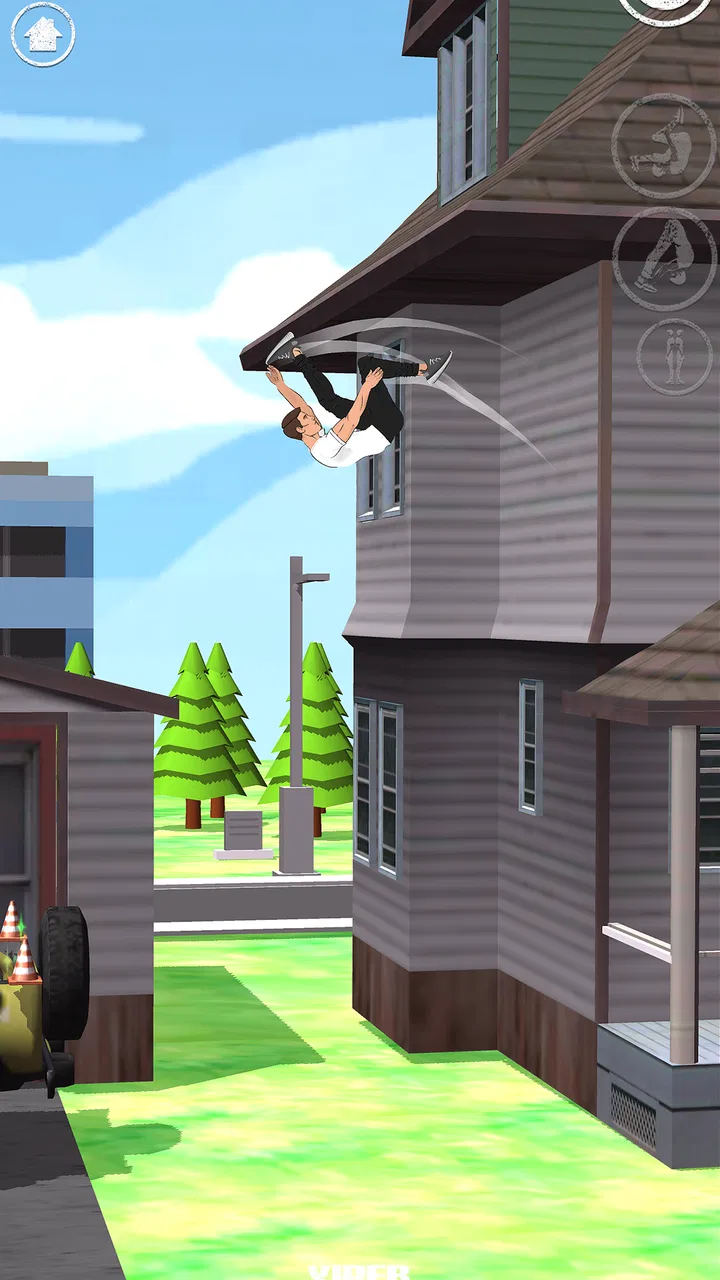
I approached SWAGFLIP - Parkour Origins expecting a quick arcade distraction, and that is exactly where it makes the strongest impression. It is a physics-driven stunt game built around timing, momentum, and the unpredictable comedy of a ragdoll character trying to complete acrobatic moves without turning every attempt into a painful-looking crash. I found it easy to understand within seconds, but much harder to control consistently once the game started asking for cleaner landings and more ambitious tricks.
The important question is not whether the game is entertaining. It is. The better question is whether its particular kind of entertainment suits you. If you enjoy short attempts, repeated practice, and laughing at failures that were almost successful, this arcade title has a lot to offer. If you want a structured platformer with precise movement, a long narrative, or calm progress that never feels random, you may quickly prefer something else.
Jordan Ross is credited as the developer, and the game has built a substantial audience since its release on September 25, 2016. It is free to start, carries a Teen content rating, and runs on devices using Android 7.0 or later. The current version is 1.7.74. Those details make it broadly accessible, but the real appeal comes from its unusual control challenge rather than from a large collection of conventional arcade systems.
You May Also Like

 Blood Strike: 2.5 Anniversary
Blood Strike’s Loadouts Turn Every Drop Into a Tactical Gamble
A close look at Blood Strike’s custom loadouts: how fast access to signature weapons reshapes its battle royale rhythm, rewards preparation, and narrows the gap between fights.

 Pandora - Music & Podcasts
Pandora’s Music Is Easy to Start, but Harder to Recover
Pandora’s strength is its low-effort path from a seed to a station. Its weak spot is how much confidence it asks you to place in connection, setup, and quiet recovery.

 8 Ball Pool
 Is Built on Rivalries, Rematches, and Routine
A close look at the rivalries, rematches, shared routines, and unanswered safety questions that turn a quick pool match into a persistent mobile community.

 Samsung Music
’s Quiet Strength Is Playing What You Already Own
Its reach comes less from spectacle than from dependable access to a personal library. That simplicity is both the app’s strongest retention engine and its ceiling.

 AccuWeather: Weather Radar
AccuWeather Review: A Quick, Clear Forecast for Everyday Decisions
For everyday plans, the best forecast is the one you can understand quickly. AccuWeather makes rain timing, radar, and local conditions easy to act on, with a few trade-offs.

 Hill Climb Racing
Why Hill Climb Racing Still Turns Crashes Into One More Run
A tiny car, a bumpy hill and one more upgrade: Hill Climb Racing keeps resurfacing because its simple chaos makes every near-miss feel personal.
More From Our News Desk



How I Decided Whether It Was Worth Keeping
I judge whether a game deserves a lasting spot by looking beyond the fun of its first few attempts: does it still give me a reason to return, and can I leave it without feeling pulled into an endless loop? Here, I focus on the difference between a quick laugh and a habit that stays enjoyable. That distinction matters when the same stunt can be satisfying to improve and tiring to repeat.
The first few minutes reveal the whole personality
My first useful test with a game like this is whether the basic action feels readable before I start thinking about scores or progression. Here, the central loop communicates itself quickly: launch the character, shape the movement through the air, and try to finish the stunt without losing control. The amusing part is that the game does not need elaborate explanation to create tension. A small mistake can turn a promising flip into a spectacular collapse, while a successful landing feels satisfying precisely because the movement looked so unstable a moment earlier.
That simplicity is a strength for casual play. I can pick it up while waiting for an appointment and understand what I am doing immediately. It also means the game depends heavily on whether you enjoy repeating the same general kind of challenge. There is no need to learn a complicated ruleset, but there is a need to accept that improvement comes from trying again rather than from discovering a completely different strategy every few minutes.
Control feel matters more than visual polish here
With a physics-based stunt game, I pay closer attention to response than to decoration. The useful question is whether my input seems connected to the character's movement, even when the result goes wrong. In this case, failure usually feels entertaining enough to make another attempt worthwhile. Still, the ragdoll behavior can create moments where the outcome looks less like a mistake I understand and more like an awkward chain reaction. That unpredictability is part of the joke, but it can also frustrate players who want every failure to teach a precise lesson.
I recommend judging the controls over a proper session rather than during a single attempt. Early failures can feel random because the timing is unfamiliar. After I began watching the character's position instead of reacting only to the apparent speed of the flip, I had a better sense of when to commit and when to stop trying to correct the movement. That is one of the game's less obvious lessons: the most dramatic-looking action is not always the safest route to a successful landing.
It works best when I treat each attempt as a small experiment
The usual arcade habit is to chase a high score immediately. I found that approach less useful here. A better workflow is to change one thing at a time: start the motion earlier, hold a movement slightly longer, or aim for a more conservative landing. When several inputs change at once, a successful result is difficult to reproduce, and a failed result teaches very little. Treating each run as a small experiment makes the physics easier to read.
This matters especially for players who normally avoid games with ragdoll mechanics. You do not need perfect reflexes from the beginning, but you do need patience with imperfect feedback. The game rewards the person who notices patterns in body position and momentum. It is less friendly to someone who wants a fixed sequence that can be memorized and repeated without adjustment.
Why the arcade format suits short sessions
I would use this as a pocket-sized reset rather than as my only game. A short session can provide a clear beginning and end because each attempt is naturally separated from the next. That makes it suitable for a commute, a break between tasks, or a few minutes when I want something active without committing to a story or a lengthy match.
There is also a social use case, even without turning the game into a formal competition. Passing the phone to a friend and watching them attempt a stunt creates instant entertainment because the consequences are easy to understand. One person can try for a careful landing while another chooses a reckless move just to see the resulting crash. That shared laughter is a stronger reason to keep the game installed than the store summary alone would suggest.
Where it clearly wins against familiar arcade choices
Compared with a standard endless runner, this game gives me more room to think about one movement rather than simply reacting to a constant stream of obstacles. Compared with a traditional platformer, it is less about walking across a carefully designed route and more about controlling a single burst of motion. Compared with a score-chasing reflex game, its failures have a physical comedy that makes losing feel less punishing.
Its biggest advantage is the combination of simple input and unpredictable physical results. That combination gives it a recognizable identity. I do not play it because it offers the deepest arcade progression; I play it because a nearly successful flip can be more amusing than a clean win in a more serious game.
What the large audience tells me, and what it does not
The game holds a 4.7 average from around 79 thousand ratings, with roughly 3.4 thousand written reviews and over 10 million installs. That level of reach supports my impression that the concept is easy for many people to pick up. It also suggests that the unusual stunt-and-crash loop has lasting appeal beyond a brief novelty.
Popularity should not be confused with universal suitability. A game can be widely enjoyed and still be a poor fit for someone who dislikes repeated attempts or physics that occasionally behave in surprising ways. I would use the audience response as a reason to try it, not as a guarantee that its control style will match your preferences.
Where another category may be the smarter choice
If your priority is precise, repeatable movement, a conventional platform game is likely to feel fairer. Its rules usually make it easier to understand exactly why a jump failed and how to correct it. If your priority is long-term progression, a more structured arcade game may provide clearer goals and a stronger sense of advancement. If you want relaxation, a puzzle game may be a better choice because this title keeps asking you to react to movement that can quickly become chaotic.
I would also skip it if you dislike watching a character fail in exaggerated physical ways. The crashes are central to the tone, not a minor side effect. Someone looking for a serious parkour simulation will probably find the humor and ragdoll behavior too loose. The game is inspired by stunt performance as entertainment, not by a realistic training routine.
Free entry and the practical cost of staying with it
The game is free, which makes trying it an uncomplicated decision. In-app purchases are listed at $1.99 per item. I would not treat spending as necessary before deciding whether the core loop works for you. The sensible approach is to play without paying, learn whether the controls feel enjoyable, and only then consider whether an optional purchase adds enough value to your own use.
The more meaningful cost is attention. Because attempts are short and failures are funny, it is easy to keep saying that I will try just one more time. That is harmless during a break, but less helpful when I am using the game to avoid a task. I found it useful to set a natural stopping point, such as ending after a successful run or after a small group of attempts. This preserves the lighthearted quality instead of turning repetition into irritation.
There is also a switching cost when moving from another arcade game. In a runner, I might focus on obstacles arriving from ahead. In a conventional platformer, I might focus on the next surface. Here, I have to think about the character's entire body and the timing of the stunt. That change is not difficult, but it requires a short adjustment period. Players coming from precision games should expect to relearn how they interpret mistakes.
Device expectations and everyday practicality
Because the minimum operating system is Android 7.0, the game is available to a broad range of Android users. That makes it a practical suggestion for someone with an older compatible phone who wants a free arcade game rather than a demanding new release. I would still keep expectations focused on the gameplay loop: the appeal is the stunt, the timing, and the crash comedy, not a large presentation built around cinematic scale.
For a parent considering it for a younger player, the Teen rating is worth taking seriously. The tone is playful, but the game is built around repeated falls and exaggerated impacts. I would make the decision based on the individual player's age and comfort with that style rather than assuming that a cartoon-like presentation automatically makes it suitable for everyone.
Three habits that make the game more enjoyable
First, I avoid making every attempt a stunt showcase. A controlled, modest movement often teaches more than an ambitious sequence. Once I understand how the character responds, I can increase the risk deliberately instead of confusing a wild result with progress.
Second, I watch the landing setup earlier than feels natural. The temptation is to focus on the flip itself because it is the most visible part of the action. In practice, the landing is what determines whether the attempt feels successful. Looking ahead gives me more time to decide whether to preserve the motion or accept that the run is already turning into a crash.
Third, I use failures to identify one repeatable mistake. If the character consistently rotates too far, I change the timing on the next attempt rather than adding extra movement. If the landing is too short, I adjust the launch rather than trying to rescue everything in midair. This simple discipline reduces the sense that the game is random.
Who should download it first
I would recommend it to players who enjoy physics-based comedy, short arcade sessions, and the satisfaction of gradually understanding a difficult movement. It is particularly good for someone who likes sharing a game with friends because the result of each attempt is visually obvious and often funny even when it fails.
It is also a good fit for players who want a free game that can be learned quickly but not necessarily mastered quickly. The distinction matters. You can understand the objective almost immediately, yet still spend time improving your control. That creates a useful middle ground between a disposable novelty and a demanding technical game.
Who should leave it alone
I would not choose it for a child or adult who becomes annoyed when the same challenge must be repeated. I would also avoid recommending it to anyone seeking a realistic interpretation of parkour, because the title uses stunt movement as a playful arcade system rather than as a faithful simulation. Players who need a clear campaign, character development, or a strong narrative reason to continue will find the experience too focused on its central trick.
There is no shame in choosing a different arcade category. A puzzle title may be better for deliberate thinking, an endless runner may be better for constant forward motion, and a precision platformer may be better for players who want predictable rules. The right alternative depends on whether you value comedy, control accuracy, or structured progress most.
My recommendation after weighing the trade-offs
After spending time with it, I see SWAGFLIP - Parkour Origins as a strong recommendation for a specific kind of player rather than a universal arcade choice. Its free entry, approachable premise, and memorable ragdoll failures make it easy to try. The game earns its place through the feeling that every attempt might become either an impressive stunt or an entertaining disaster.
My advice is to download it when you want a light, physical arcade challenge and are comfortable learning through repetition. Give it a fair session instead of judging the first few crashes, and use the one-change-at-a-time approach to understand its timing. If the movement still feels arbitrary after that, switching to a more precise platformer is the sensible choice.
The final decision is simple: choose it for quick laughs, experimental control, and stunt attempts that are fun even when they fail. Skip it when you need predictable movement, deep progression, or realism. For me, that focused identity is enough to make it worth keeping around, especially as a free game that can turn a few spare minutes into a surprisingly engaging challenge.
FAQs for SWAGFLIP - Parkour Origins
01What is SWAGFLIP - Parkour Origins about?
SWAGFLIP - Parkour Origins is an adrenaline-pumping game that lets players experience the thrill of parkour. It combines realistic physics with challenging levels where you perform flips and stunts. As you progress, the levels become increasingly complex, requiring precision and skill. It's perfect for anyone interested in action-packed, skill-based gameplay.
02Is SWAGFLIP - Parkour Origins free to play?
Yes, SWAGFLIP - Parkour Origins is free to download and play. However, the game includes optional in-app purchases that can enhance your gaming experience. These purchases may include removing ads, unlocking new levels, or acquiring special abilities. It's entirely possible to enjoy the game without spending any money, though.
03What are the device requirements for SWAGFLIP - Parkour Origins?
SWAGFLIP - Parkour Origins requires a device running Android 5.0 or later, or iOS 10.0 or later. It’s optimized for both smartphones and tablets, ensuring smooth performance. Make sure your device has at least 100MB of free storage space to accommodate the app and any additional content that may be downloaded during updates.
04What kind of controls does SWAGFLIP - Parkour Origins use?
The game features intuitive touch controls designed for mobile devices. Players use simple taps and swipes to perform stunts and navigate through levels. The controls are responsive, allowing for precise movements, which is crucial for executing complex parkour maneuvers. A brief tutorial is available to help new players get accustomed to the controls.
05Can SWAGFLIP - Parkour Origins be played offline?
Yes, SWAGFLIP - Parkour Origins can be played offline, which is great for those who want to enjoy the game without an internet connection. However, some features like leaderboard rankings and in-app purchases will require connectivity. Playing offline doesn't compromise the core gameplay experience, making it convenient for on-the-go entertainment.
Pros
- Intuitive controls make gameplay accessible.
- Diverse levels with increasing challenges.
- Visually appealing graphics and animations.
- Smooth performance with minimal lag.
- Regular updates with new features.
Cons
- Can become repetitive over time.
- Limited customization options for characters.
- Occasional ads disrupt gameplay.
- Some levels feel too easy for seasoned players.
- In-app purchases can be pricey.

SWAGFLIP - Parkour Origins
Gallery